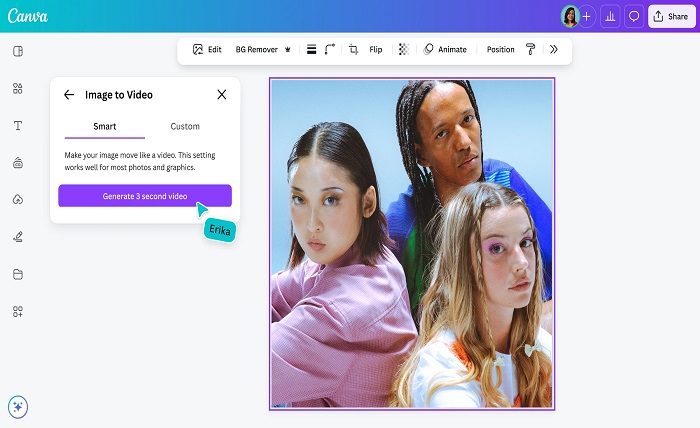
A great photo is a starting point. In 2026, the best image to video AI tools turn that starting point into a living, moving clip with a single click. Product shots get motion and depth. Portraits breathe and blink. Landscapes shift with wind and light. What used to require an animation team can now be done from a browser in under two minutes.
The best image to video AI generator in 2026 is the one that preserves your source image’s identity while adding believable, controllable motion, and fits your budget and workflow. I spent two weeks running the same test images through every tool on this list before ranking them. I guarantee at least one of these will fit what you are building.
Best Image to Video AI Generators at a Glance
| Tool | Best For | Free Plan | Starting Price | Model Access | Native Audio |
| Magic Hour | All-in-one multi-model platform | Yes (no signup) | $10/mo (annual) | Kling, Veo, Sora, Seedance, LTX | Yes |
| Runway Gen-4.5 | Directed production, filmmakers | Yes (limited) | $15/mo | Proprietary | No |
| Kling 3.0 | Multi-shot storytelling, motion | Yes (watermarked) | ~$10/mo | Kling 3.0 | Yes |
| Google Veo 3.1 | Photorealism, marketing video | Limited access | Varies | Veo 3.1 | Yes |
| Pika 2.5 | Social content, physics effects | Yes | $8/mo | Proprietary | Partial |
| Luma Ray3 | Cinematic, artistic motion | Yes (5/day) | $29.99/mo | Ray3 | No |
| Seedance 2.0 | Brand content, cinematic continuity | Yes (limited) | ~$10/mo | Seedance 2.0 | Partial |
| Hailuo / MiniMax | Expressive character animation | Yes | $9.99/mo | MiniMax | Yes |
| PixVerse V6 | Social clips, free testing | Yes | $19/mo | PixVerse V6 | Yes |
| Wan 2.2 | Developers, open-source pipelines | Yes (open-source) | Free | Wan 2.2 | No |
- Magic Hour
The best all-in-one platform for image to video AI generation.
Magic Hour is the strongest image to video AI platform in 2026 because it gives you access to every major frontier model from a single dashboard. Upload a still image, choose between Kling 3.0 for multi-shot storytelling, Veo 3.1 for photorealistic motion, Sora 2 for extended cinematic clips, or LTX-2 for audio-first generation, all without switching platforms or managing separate subscriptions. That model flexibility is what separates Magic Hour from every standalone tool on this list.
No signup is required to start generating. The free tier gives you three genuine generations per day, not a watermarked demo. Credits never expire on any paid plan.
Pros:
- Access to six frontier models: Kling 3.0, Kling 2.5, Veo 3.1, Sora 2, Seedance 2.0, LTX-2
- No signup required to try, generate immediately without creating an account
- Credits never expire on any plan
- One-click multi-step workflows: animate, upscale, and extend in a single platform
- Parallel generation with no concurrency cap, ideal for teams producing at volume
- Thousands of click-to-create templates reduce creative friction on every brief
- Best-in-class face swap, lip sync, and talking photos alongside image-to-video
- Full API parity across all tools for developers and custom integrations
- Outputs in 9:16, 16:9, and 1:1 for every major social and marketing platform
- Optimized for both desktop and mobile
- Founder-level support responses, typically within hours
- Trusted at scale by Meta, NBA, Shopify, L’Oreal, Dyson, and Cisco
- Weekly feature releases keep the platform current as frontier models improve
Cons:
- Premium models (Kling 3.0, Veo 3.1, Sora 2) require a paid plan to access
- Credit costs vary by model and resolution, heavy Veo or Sora use adds up on the Creator tier
- Some advanced per-model controls are not uniformly available across all six models
If you want Kling 3.0, Veo 3.1, and Sora 2 all available from one dashboard with credits that never expire and no signup barrier to start, Magic Hour is the platform built for that workflow.
Pricing:
- Free: 3 generations per day, no signup required; 400 credits on account creation
- Creator: $15/month or $10/month billed annually (120,000 credits per year)
- Pro: $39/month or $25/month billed annually (300,000 credits per year)
- Business: $99/month or $66/month billed annually (840,000 credits per year, 4K exports, unlimited concurrent generations)
2. Runway Gen-4.5
Best for filmmakers and ad teams who need precise directorial control over animated clips.
Runway Gen-4.5 is the professional standard for directed image-to-video production. Camera Motion controls allow you to specify push, pull, pan, tilt, orbit, and zoom for each generation. Multi-Motion Brush lets you apply different motion vectors to different regions of a single image, giving you frame-level control that most other tools cannot match. For agencies and studios producing client work where every camera move is intentional, Runway remains the strongest tool for that specific job.
Pros:
- Best-in-class camera motion controls: push, pan, tilt, orbit, zoom per generation
- Multi-Motion Brush applies different motion to separate image regions
- Act One enables performance-driven character animation
- Strong temporal consistency across extended multi-second clips
- Thorough API documentation for developer integrations
Cons:
- Proprietary model only, no access to Kling, Veo, or Sora
- Free tier is 125 one-time credits with watermarked exports
- More expensive per output than multi-model platforms at comparable volume
- Raw quality benchmark ranking has slipped from its late 2025 launch position
For directed production work where camera precision matters more than model variety, Runway is still the strongest dedicated tool. It is not the right fit for high-volume iteration or daily social content creation.
Pricing:
- Free: 125 one-time credits
- Standard: $15/month (625 credits/month)
- Pro: $35/month (2,250 credits/month)
- Unlimited: $95/month
3. Kling 3.0
Best for multi-shot storytelling and consistent motion from a still image reference.
Kling 3.0, developed by Kuaishou, has four entries in the Artificial Analysis mid-2026 benchmark top 10, making it one of the most consistently strong performers across different image types and motion styles. It supports multi-scene generation with native audio and camera control, with clip windows up to 15 seconds per generation. For image-to-video workflows that need motion consistency and narrative flow across multiple shots, Kling 3.0 is the strongest dedicated model available.
Pros:
- Four Kling models in the Artificial Analysis top 10 as of mid-2026
- Excellent motion consistency when animating human subjects from still images
- Native audio generation available on most workflows
- Up to 15-second clip durations, longer than most competitors
- Strong camera control without requiring deep prompt engineering
Cons:
- Native Kling platform interface is less polished than Western-market tools
- Free tier includes watermarks and limited resolution output
- Queue times increase noticeably during peak usage periods
- Not a full content creation suite outside of video generation
Kling 3.0 is the strongest dedicated model for turning still images into structured, multi-shot narrative content. Accessing it through Magic Hour gives you more workflow flexibility than using the standalone platform directly.
Pricing (native platform):
- Free: limited daily generations with watermark
- Standard: approximately $10/month
- Pro: approximately $35/month
4. Google Veo 3.1
Best for hyper-realistic motion from photography and marketing-grade source images.
Veo 3.1 holds a top-three position on the Artificial Analysis leaderboard as of mid-2026. It is the strongest model for photorealistic output: natural lighting adaptation, accurate human movement, and tight visual fidelity to the source image. Native audio generation means synchronized dialogue and ambient sound generate in the same pass. For marketing teams animating high-quality product or lifestyle photography, Veo 3.1 delivers results that are difficult to match.
Pros:
- Best-in-class photorealism when animating real-world source images
- Native audio generation with synchronized dialogue support
- Strong fidelity to source image identity and lighting
- Top-three Artificial Analysis leaderboard position as of mid-2026
Cons:
- Direct consumer access is limited through Google VideoFX, which has a waitlist
- Per-generation cost is high via direct API access
- Not a standalone creation platform with workflow tools or templates
- Less flexible for stylized, illustrated, or abstract source images
Veo 3.1 is the right model when photorealistic fidelity to your source image is the only metric that matters. For most creators, accessing it through Magic Hour is more practical than direct API integration.
Pricing:
- Available through Magic Hour paid plans
- Direct access via Google VideoFX invitation or waitlist
5. Pika 2.5
Best for social content creators who want fast, physics-aware motion from still images.
Pika 2.5 introduced a physics-based generation engine that simulates weight, fluid dynamics, and impact. The Pikaffects library, with presets like Crush and Melt, Inflate and Pop, and Shatter, applies dramatic, shareable motion to still images in a way that most other models do not attempt. Generation speed is under two minutes per clip, which is the fastest among tools on this list.
Pros:
- Physics-aware generation produces distinctive, high-energy motion from still images
- Under 2-minute render times, fastest tool tested
- Pikaffects library enables fast creative experimentation
- Beginner-friendly interface with a minimal learning curve
- Competitive entry pricing and a useful free tier
Cons:
- Output style is more stylized than strictly photorealistic
- Maximum 10-second clip length, shorter than several competitors
- Limited directorial control compared to Runway or Kling
- No access to third-party frontier models
Pika is purpose-built for daily social publishing. If speed, iteration, and platform-native formats matter more than cinematic precision, it delivers more per dollar at the entry tier than most alternatives.
Pricing:
- Free: available
- Basic: $8/month
- Standard: $28/month
- Pro: $58/month
6. Luma Ray3
Best for cinematic and aesthetically distinctive motion from still image inputs.
Luma AI’s Ray3 model produces some of the most visually striking image-to-video output in 2026. The motion has a fluid, cinematic quality that works well for lifestyle photography, product scenes, and artistic content. Ray3 improved meaningfully on identity preservation compared to earlier Dream Machine releases, making it more reliable when animating faces and branded subjects.
Pros:
- Distinctive cinematic motion with strong visual polish
- Improved identity preservation over earlier Luma models
- Well suited for product lifestyle, atmospheric, and artistic content
- Developer-accessible API
- 5 free credits per day, no signup required
Cons:
- Output aesthetic skews artistic rather than strictly photorealistic
- Less directorial control than Runway
- Free plan limited to 5 credits per day
- Not an integrated creation suite with workflow tools or templates
If you are animating music video visuals, atmospheric photography, or lifestyle content where mood and aesthetic carry more weight than strict prompt accuracy, Luma Ray3 is worth testing before committing to a subscription.
Pricing:
- Free: 5 credits per day
- Lite: $9.99/month (non-commercial)
- Plus: $29.99/month (commercial use, HDR support)
- Unlimited: $94.99/month
7. Seedance 2.0
Best for brand content and cinematic continuity across related image-to-video generations.
Seedance 2.0 reached the top of the Artificial Analysis benchmark leaderboard at its launch in early 2026. It performs particularly well on structured visual references and character consistency across related clips. For brand campaigns where multiple animated images need to feel like they belong to the same visual world, Seedance 2.0 is among the strongest available options. Start and end frame control adds precision over scene structure.
Pros:
- Top benchmark performance at launch in early 2026
- Strong character and identity consistency across related generations
- Start and end frame control for precise motion arc building
- Handles structured brand visual references well
Cons:
- Native audio not universally available in all platform integrations
- Smaller community resource base than Kling or Runway
- Higher prompt sensitivity than more forgiving consumer-facing tools
- Specs and capabilities continue to update rapidly
Seedance 2.0 rewards creators who approach image-to-video with a storyboard mindset and clear visual references. It is a production tool built for intentional use.
Pricing:
- Available in Magic Hour paid plans
- Native platform pricing varies
8. Hailuo / MiniMax
Best for expressive, character-driven animation from portrait and character images.
Hailuo, developed by MiniMax, handles expressive motion prompts more confidently than most alternatives. When animating character portraits or illustrated images with dramatic motion or personality, Hailuo leans into the brief rather than producing cautious or generic output. Native audio is available on most generations, and the platform prices competitively against tools with higher profiles.
Pros:
- Handles expressive and creative motion prompts more confidently than most tools
- Native audio support on most generations
- Fast generation times
- Competitive pricing for the quality level
Cons:
- Less suited for photorealistic product or lifestyle photography
- Interface and documentation less polished than Western-market platforms
- Limited advanced directorial controls
- Smaller creator community for prompt guidance
Hailuo regularly outperforms expectations on prompts that other models handle too cautiously. If your source images are character-forward or entertainment-focused, it is worth adding to your testing shortlist.
Pricing:
- Free: available
- Standard: $9.99/month
9. PixVerse V6
Best for creators who want meaningful free testing before committing to a plan.
PixVerse V6 supports multi-shot generation, native audio, and strong motion consistency at a level that previously required a premium subscription elsewhere. The free tier is one of the most genuinely useful for evaluation purposes, allowing creators to assess real output quality on their own source images before upgrading.
Pros:
- Free tier allows testing without watermark restrictions on output quality
- Multi-shot generation supports more complex sequences from a single image
- Native audio on most generations
- Clean, accessible interface for new and experienced users
Cons:
- Smaller model selection than multi-model platforms
- Less community documentation and prompt guidance than top-tier tools
- Advanced camera controls still developing
- Limited API options compared to API-first platforms
PixVerse V6 gives more honest evaluation room than most free tiers on this list. For creators who want to test their actual source images before spending money, it is the strongest starting point.
Pricing:
- Free: available without watermark restrictions
- Standard: $19/month
- Premium: $39/month
10. Wan 2.2
Best for developers and technical teams who need full pipeline control without recurring fees.
Wan 2.2 is the strongest open-source image-to-video option available in 2026. Released under an Apache 2.0 license, it can be run locally, fine-tuned for specific image types and motion styles, and integrated into custom pipelines at no usage cost. Motion coherence is strong for an open-source model, and the active community contributes regular improvements.
Pros:
- Apache 2.0 license: no usage restrictions or recurring fees when self-hosted
- Full fine-tuning capability for custom image types and visual styles
- Strong motion coherence for an open-source model
- Active community and research development
- Available via Magic Hour for cloud-based use without local setup
Cons:
- Local setup requires meaningful technical infrastructure and expertise
- Output quality does not match frontier commercial models on raw benchmarks
- No built-in workflow tools, templates, or interface
- Hardware investment required for reliable local generation
For developers building production pipelines who need full stack control over the image-to-video process, Wan 2.2 is the clear choice. For everyone else, cloud-based access through a platform like Magic Hour is the more practical path.
Pricing:
- Open-source: free to self-host
- Cloud access available through Magic Hour paid plans
How We Chose These Tools
I ran the same test set through every tool on this list over two weeks. The source material included four image types: a close-up portrait, a product shot on a clean background, a landscape photograph, and an illustrated character. Each image was paired with the same three motion prompts: a subtle ambient motion, a moderate camera move, and a dynamic subject-forward action.
Evaluation criteria:
- Identity preservation: how accurately the output maintains the source image’s visual identity across frames
- Motion quality: realism and smoothness of the generated motion
- Prompt adherence: whether the motion matches the described intent
- Temporal consistency: stability of the output without flickering or visual drift
- Ease of use: time from upload to download, interface clarity
- Pricing value: credit efficiency, free tier usefulness, commercial rights clarity
- API availability: for developers and teams building integrations
Identity preservation and temporal consistency received the heaviest weighting. For image-to-video workflows, those are the two factors that determine whether an output is usable in a real production context.
The Market Landscape and Trends
As of June 2026, image-to-video generation has moved firmly from experimental to production tool. A few key shifts define where the category is heading:
Identity preservation has improved dramatically. The core challenge in image-to-video has always been maintaining the source image’s visual identity across frames. Kling 3.0, Veo 3.1, and Seedance 2.0 have all made significant progress on this in the past 12 months, and the gap between the best and worst tools has widened as a result.
Start and end frame control is becoming standard. The ability to specify both the opening and closing frame of a generated clip, rather than just the starting image, gives creators much more control over narrative structure and visual continuity. Seedance 2.0 and several Kling models support this natively.
Native audio is increasingly expected. Kling 3.0, Veo 3.1, Sora 2, and LTX-2 all support native audio generation alongside image-to-video output. For social and marketing content, silent clips are at a growing disadvantage.
Multi-model platforms are winning over standalone tools. Managing separate subscriptions to stay current with the best models is not a sustainable creative workflow. Platforms that centralize model access, like Magic Hour, are seeing strong adoption from creators who want the best model for each job without the administrative overhead.
Open-source options are production-viable. Wan 2.2 and HunyuanVideo from Tencent, both under permissive licenses, have closed the quality gap with commercial tools for developers who can manage local infrastructure. The open-source tier of the category is stronger than it has ever been.
Final Takeaway
There is no single best image to video AI generator for every use case in 2026. Here is how to match your needs to the right platform:
- Best all-in-one platform: Magic Hour. Frontier model access across Kling, Veo, Sora, and Seedance, no-signup free tier, credits that never expire, and a full creation suite at $10 to $15 per month.
- Best for directed production: Runway Gen-4.5. When camera control and frame-level motion precision matter more than model variety.
- Best for photorealistic photography: Google Veo 3.1 via Magic Hour. The strongest output quality for animating real-world source images.
- Best for multi-shot narrative: Kling 3.0. Multiple benchmark top-10 placements and 15-second generation windows for structured storytelling.
- Best for social content speed: Pika 2.5. Sub-2-minute renders and physics-aware effects built for daily social publishing.
- Best for developers: Wan 2.2. Apache 2.0, fully fine-tunable, no recurring fees when self-hosted.
The most useful step before committing to any subscription is running your actual source images through two or three tools with the same motion prompt. Review articles can get you to a short list. The usable-output rate on your specific images and use case is the only metric that predicts real workflow fit.
Frequently Asked Questions
What is the best free image to video AI tool in 2026?
Magic Hour offers the strongest free tier: three genuine generations per day with no signup required, and 400 bonus credits when you create an account. No watermark prevents you from evaluating real output quality on your own images. Luma Ray3 also offers 5 free credits per day with no signup. Both are strong starting points before committing to any paid plan.
How do image to video AI generators work?
You upload a still image and optionally add a text prompt describing the motion or style you want. The AI model analyzes the spatial depth, lighting, and subject relationships in the image, then predicts frame-by-frame motion that is consistent with both the source image and the motion prompt. More advanced models also process camera direction cues, start and end frame references, and audio instructions in the same generation pass.
Can AI-generated image to video clips be used commercially?
Yes, on most platforms with a paid plan. Magic Hour grants full commercial rights on any paid subscription (Creator, Pro, or Business). Free tiers are typically limited to personal, non-commercial use. Always verify the specific terms of service for the platform and plan before using generated content in ads, client deliverables, or product campaigns.
What types of images work best for AI animation?
High-resolution images with clear subjects, good lighting, and minimal background clutter tend to produce the cleanest results. Portrait images, product shots on clean backgrounds, and landscape photography all animate well on most tools. Low-resolution images, extreme wide-angle distortion, and heavily compressed JPEGs produce more visual artifacts across all models. For best results, use the highest quality source image available.
How long can image to video AI clips be in 2026?
Clip length varies by model. Sora 2 supports up to 60 seconds, Veo 3.1 up to 56 seconds, LTX-2 up to 30 seconds, and Kling 3.0 up to 15 seconds per generation. Pika 2.5 caps at 10 seconds. For longer content, most platforms support video extension tools that continue a clip from its final frame.