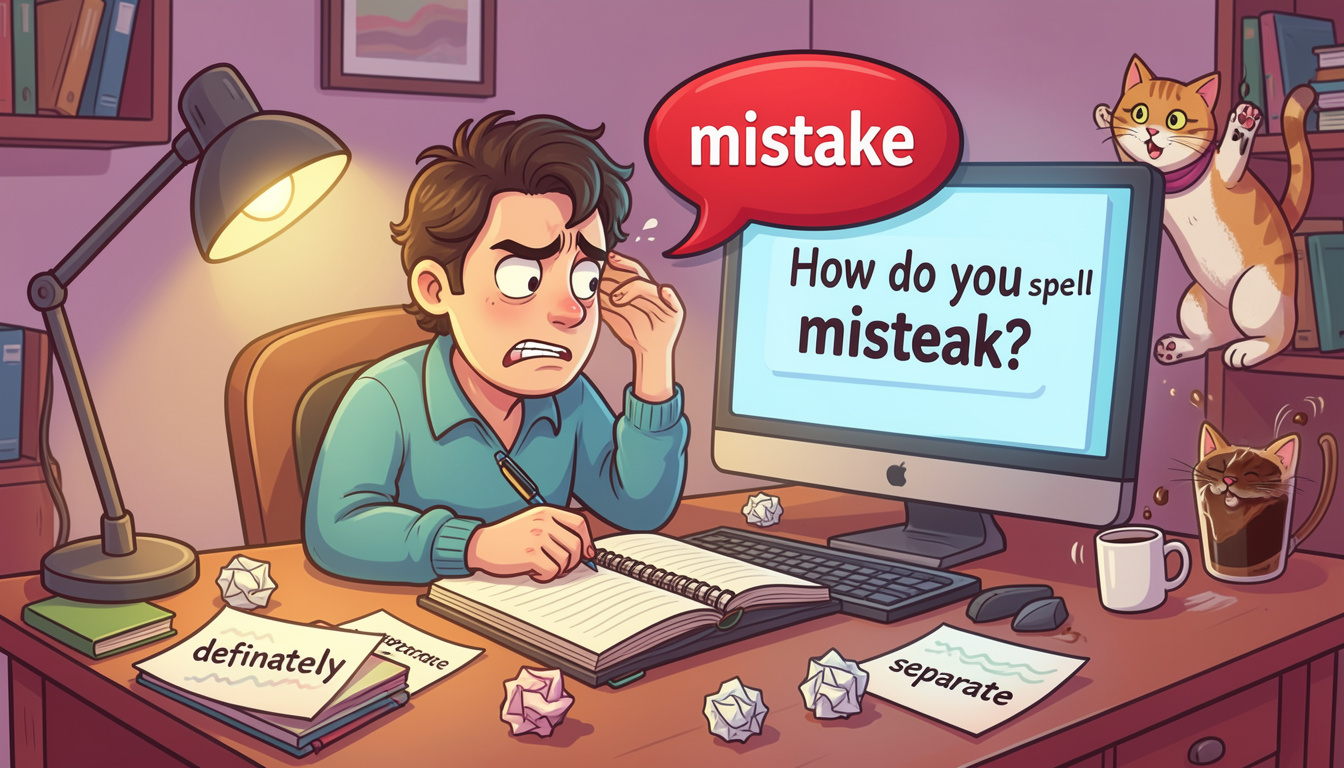
Everyone makes mistakes — especially when it comes to spelling. Whether you’re a student writing a paper, a professional crafting emails, or a content creator working online, spelling mistakes can sneak in at the worst times. So, when people ask, “How do you spell mistake?”, there’s usually more behind that question than meets the eye. It’s not just about writing the word mistake correctly — it’s about understanding how our brains handle spelling, why we misspell words, and how to improve.
The Simple Answer: “Mistake” Is Spelled M-I-S-T-A-K-E
Let’s start with the basics. The correct spelling of the word mistake is straightforward: M-I-S-T-A-K-E. Grammatically, it’s a noun or verb depending on how you use it.
- As a noun, it means an error, wrong judgment, or misunderstanding — e.g. “That typo was a mistake.”
- As a verb, it means to misunderstand or misidentify something — e.g. “I mistook her for someone else.”
Although the spelling seems simple, this word often appears in ironic contexts where the person writing or speaking actually makes a mistake while discussing mistakes! That’s part of what makes it a fun topic to explore.
The Irony of Spelling “Mistake” Wrong
It’s not rare to see ironic online posts like “How do you spell misteak?” or “How do you spell mistak?” These humorous versions remind us how easy it is to slip up — even on words we use every day.
Spelling mistakes usually happen because of:
- Phonetic confusion: People spell words how they sound. For example, “definately” instead of “definitely.”
- Typing errors: Fast typists miss letters or rearrange them. For instance, “mistaek” often appears when fingers move too quickly.
- Mind slips: Your brain knows what you mean, but your fingers do something else.
- Homophone confusion: Words that sound the same but are spelled differently (like “there,” “their,” and “they’re”) lead to mix-ups.
“Mistake” itself sound clear enough phonetically, yet people still type variations — partly because irony and humor play a role.
Why We Make Spelling Mistakes
Spelling errors aren’t just about carelessness. There’s actual psychology behind them. Humans depend on automatic processing for familiar words. When you type or write, your motor memory takes over. Once your brain decides what you want to say, your fingers or pen follow habitual patterns. That’s why you might write hte instead of the, even though you know the correct spelling.
Spelling mistakes happen because:
- We rely too heavily on speed instead of accuracy.
- Auto-correct and spell-check tools have made us less attentive.
- Visual memory differs from phonetic memory — some people picture words, others sound them out.
- Context distractions (background noise, multitasking, fatigue) make errors more likely.
That’s why proofreading matters, even when software claims to “fix everything.”
The Evolution of Spelling
Interestingly, spelling itself hasn’t always been standardized. In early English, words were spelled inconsistently. For example, “mistake” appeared as mystake or misteke in older texts. It wasn’t until dictionaries like Samuel Johnson’s in the 18th century that English spelling gained uniformity.
Today, we take standard spelling as a given. Our tools — autocorrect, Grammarly, and spell-check — maintain consistency. Yet despite all this help, typing “mistake” wrong remains one of the most common ironic errors on social media.
Commonly Misspelled Words (Besides “Mistake”)
If you’re curious how often people misspell words, here’s a list of high-frequency culprits. These aren’t just tricky words — they’re ones we use daily but often get wrong:
- Definitely (often written as “definately”)
- Separate (“seperate”)
- Occurred (“occured”)
- Receive (“recieve”)
- Accommodate (“accomodate”)
- Embarrass (“embarass”)
- Their / There / They’re
- Effect / Affect
- Your / You’re
Pro tip: noticing patterns helps. Many misspellings arise from double letters, misplaced vowels, and confusing word pairs with similar pronunciation.
How to Avoid Making Spelling Mistakes
Thankfully, fixing spelling mistakes is easier than ever. The trick lies in combining technology with active learning. Here are six practical habits to sharpen your spelling:
- Read regularly. Exposure to accurate language imprints correct spellings in your visual memory.
- Slow down your typing. Accuracy beats speed when writing important messages.
- Proofread backwards. Reading text from end to start helps spot errors your brain skips.
- Use spell-check intelligently. Tools like Grammarly or browser checkers catch typos but still need human oversight.
- Write by hand occasionally. Handwriting activates your memory differently, strengthening word retention.
- Keep a personal “mistake list.” When you notice recurring misspellings, note them down and revisit weekly.
Language mastery is repetition and awareness — more than perfection.
The Role of Digital Tools in Correct Spelling
In the digital workspace, spelling accuracy carries huge importance. Whether you’re crafting a blog post, sending business emails, or writing ad copy, one misspelled word can shift perception. Clients, readers, or viewers might subconsciously associate sloppy text with low credibility.
Luckily, digital tools do more than correct typos; they educate users. Modern writing assistants highlight why a word is incorrect — helping users learn actively rather than blindly accept corrections.
For instance:
- Grammarly offers real-time writing suggestions with explanations.
- Google Docs automatically corrects simple words while flagging ambiguous ones.
- LanguageTool detects regional spelling patterns and helps writers maintain consistency in British vs. American English.
So, while you might never again wonder “How do you spell mistake?”, tools ensure even subtle errors are handled smoothly.
When Spelling Mistakes Become Creative
Interestingly, mistakes aren’t always bad. In branding, advertising, and art, intentional misspellings create uniqueness — think “Froot Loops,” “Lyft,” or “Tumblr.” These altered spellings differentiate products while making them memorable.
The psychological principle here is distinctiveness: unusual forms grab attention faster. However, this creativity works only when intentional. If a resume or academic essay contains misspelled words, it looks unprofessional. But in marketing and design, quirky spelling can be strategic.
Example: a coffee shop naming itself “Brewtiful Mornings” blends humor with wordplay. That “mistake” becomes style.
When a “Mistake” Isn’t One
Sometimes, people assume a spelling is wrong when it’s a variation of dialect or regional usage. American and British spellings differ widely — “color” vs. “colour,” “organize” vs. “organise.” Neither is wrong. The key is consistency. Choose one regional form and stick with it across your content.
In branding or international communication, adapting your spelling to context builds rapport. For example, US-based marketing may prefer color, while UK readers expect colour. Both correct; just different standards.
Turning Mistakes into Learning Opportunities
Every spelling error carries useful feedback. That feedback strengthens memory more than perfection. When you notice you’ve spelled something wrong, the correction process embeds learning neurologically deeper than just memorizing words.
So, the next time you type “mistak” instead of “mistake,” you’re not failing — you’re engaging your brain. It’s part of mastering language iteratively.
Learning from mistakes involves:
- Acknowledging the error without frustration.
- Correcting it consciously.
- Repeating proper use deliberately.
That simple mental sequence builds lifelong accuracy.
The Bigger Picture: Mistakes Define Growth
Ultimately, asking “How do you spell mistake?” touches something universal. Everyone — from early students to top professionals — asks this kind of question. It reminds us that imperfection is where progress begins.
Mistakes, including spelling ones, mark curiosity and growth. Each correction teaches attention, patience, and clarity. English evolves through trial, error, and adaptation, much like personal learning does.
So here’s the takeaway: yes, “mistake” is spelled M-I-S-T-A-K-E, but the act of making one isn’t shameful — it’s foundational. Every typo becomes a tiny teacher reminding you that communication gets sharper every time you notice and improve.
And the irony? The word “mistake” might just be the most perfect word to misspell — because it defines the thing we’re all allowed to make.