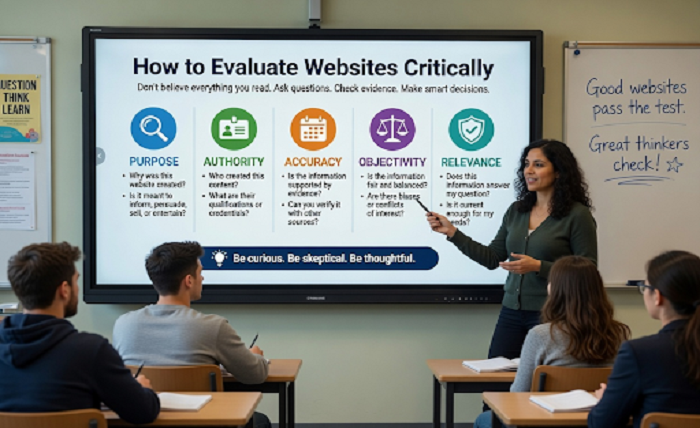
Ask a room full of students where they go to check facts, and almost none of them will name a direct trusted source. Instead, they’ll name a search engine. That’s not laziness: it’s just what happens when you lack the correct knowledge and can find anything published in one place. To cite an instance, AI can today crank out a passable article in ten seconds, and ranking near the top gets mistaken for some kind of stamp of approval.
Most people, including students, think just because a website shows up in the top 10 search results it’s a credible source. At this point, teaching students to evaluate websites isn’t a bonus unit you squeeze in before the research paper’s due. It’s the skill everyone needs to know and depend on. In this article, we are addressing modern challenges, including manipulated media, and provide practical strategies to build students’ online research skills and digital citizenship.
Why Critical Website Evaluation Matters
Misinformation doesn’t spread because people are careless readers. It spreads because a slick fake and a rushed written piece can look exactly like real reporting if you’re only skimming. A digital marketer writing about vaccine safety, or a nutrition claim they saw on TikTok is going to run into a dozen sources that sound completely authoritative but aren’t.
A few things pushed this from nice-to-have to genuinely urgent. Most research happens online now, often starting and ending with a single search. Algorithms don’t reward accuracy, they reward whatever keeps people scrolling, so the loud, dramatic version of a story usually beats the careful, boring, accurate one to the top.
Furthermore, AI quietly took away the one shortcut students used to lean on without realizing it: bad writing as a warning sign. A clunky page used to tell you something. Now it might be more trustworthy than the polished one next to it.
Not Every Website Is Reliable
The internet has never before been flooded with so much content and websites as it is at this point. Trustworthy sites are hard to find because search engines like Google can’t keep up. There is on the other hand progress, but still the skill to evaluate websites critically depends on us humans. The first step is to start with the basics.
The Domain Myth
Websites and platforms that have .gov, .edu, or established news outlets with .com, .org, including personal blogs and forums, don’t guarantee trust and accuracy. More and more pages are built purely to farm traffic. Each carries a different baseline level of accountability. None guarantees accuracy on its own.
A .gov domain confirms the publisher is a government body, but it says nothing about whether a specific claim is current or complete. And .org used to mean nonprofit status and give some sort of authority. However, anyone can set up a .org domain. Plenty of advocacy groups register .org domains for exactly one reason: the extension sounds trustworthy, and they know it.
Identifying Intent and Bias
Every website exists for a reason. Before students pick apart the content, get them asking why the page exists at all — to inform, sell, persuade, entertain, or push an agenda? A supplement ad and a peer-reviewed study can cover the same topic, but the one trying to sell you something will only ever show you the evidence that helps the sale.
From there, walk through the usual suspects: political bias, commercial bias, confirmation bias, emotionally loaded language, cherry-picked reporting. None of these automatically disqualify a source. They just flag where a student needs to look harder.
The Core Skills: Author, Evidence, Currency
To be able to verify if a website is trustworthy, such as Kasinoranking.com, students should learn to vet the source. It starts with understanding who the author is. An unnamed author isn’t an automatic red flag, but it should trigger scrutiny. Is the author identified? What are their actual credentials, not just a job title that sounds adjacent to the topic? Can that expertise be checked somewhere else?
The next step would be to demand evidence from the source. Most students skip this because it takes real effort. Are claims backed by actual data? Are studies named and linkable? Do statistics trace back to a real organization instead of a vague “studies show”? A useful classroom rule: if a claim can’t be traced to its original source in a couple of clicks, it’s unverified. An unverified source doesn’t necessarily mean it’s false, and that’s its own category worth teaching.
It is also common that old information doesn’t announce itself as old. A three-year-old article on tax law or medical treatment can resurface on social media stripped of context and get read as current. Health, tech, law, and finance are especially date-sensitive. Students should learn to make checking the date a reflex.
Design and Rankings Aren’t Proof of Anything
Anyone can build a polished-looking site in an afternoon now. Attractive design doesn’t equal credibility. In fact, some of the most rigorous government and academic resources look plain on purpose. Evaluation has to happen at the content level.
Same goes for search rankings. Showing up first on Google means a page won at SEO, nothing more. Sometimes that’s earned through solid content. Just as often it’s keyword targeting, backlinks, or a paid ad dressed up to look organic. Students need to actually notice the “Sponsored” label instead of scrolling past it, and sit with the fact that ranking well and being right are two completely different things.
AI-generated content is also fluent enough now that “well-written” has basically stopped meaning anything as a trust signal. Students need direct exposure to what they’re up against. The point isn’t to avoid AI content, but to understand it needs the same verification as anything else, often more.
Frameworks That Make Evaluation Repeatable
Two frameworks cover most of what a classroom needs. CRAAP (Currency, Relevance, Authority, Accuracy, Purpose) suits a slower research-paper pace. SIFT (Stop, Investigate the source, Find better coverage, Trace claims to the original) is built for speed.
Practice beats theory here. Have students compare two outlets covering the same story. Hand them a mixed stack of good and bad sites and make them sort it out loud. Run a debunked story through SIFT step by step. Track one claim across three independent sources. Try a reverse image search together and watch a photo unravel.
A short mental checklist worth drilling until it’s automatic: Who wrote this? Why was it published? Is there real evidence? Is it current? Can I confirm it elsewhere? Does it sound biased? Are sources named? Would an actual expert agree?
Evaluating a website critically is about swapping gut instinct for an actual process. Doing it enough times, and the process stops feeling like a process.